
Google Photos’ Unlimited Free Storage Could Clobber Apple’s Expensive iCloud


How much does a terabyte of photo storage cost? On iCloud, $240 a year. Dropbox, $100. Microsoft OneDrive, $84.

Google, $0. It’s free on desktop, Android, and iOS.

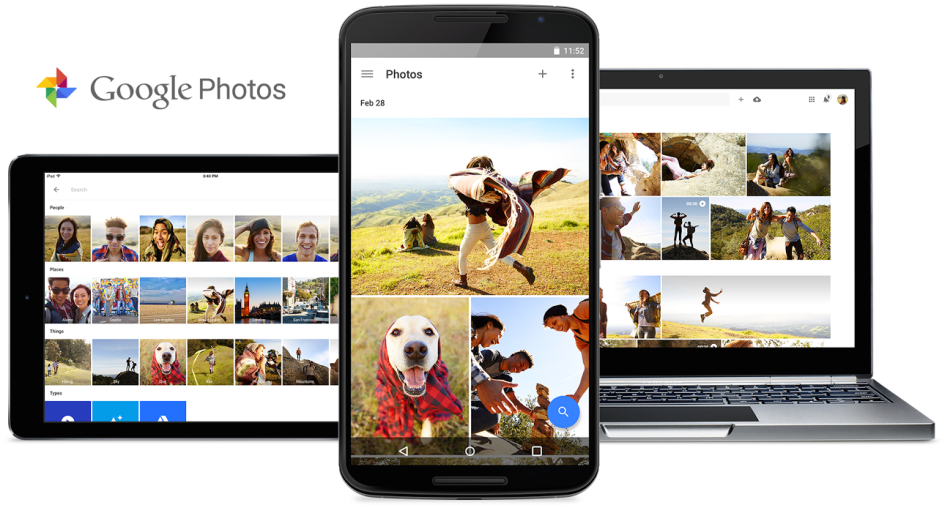
Today, Google announced its new Google Photos product, which offers unlimited free storage of photos and videos. The only limits are that photos must be under 16 megapixels, and video resolution is capped at 1080P.

If the photos and videos are bigger, Google will compress them, but says the visual quality is virtually untouched. With auto-backup from its iOS and Android apps, you can forget worrying about saving your photos, and you can forget paying to store them.
Google Photos

Photos Are A Computer Vision Goldmine

Other services are still trying to make money more directly from photos. Flickr offers 1 terabyte free, but you and your viewers have to endure frequent full-page ads from its parent company Yahoo. Amazon offers free unlimited storage, but you have to buy a $99 a year Prime subscription.

But Google is willing to throw its money around. It earns enough on search ads that it can completely subsidize photo storage as a long-term investment. Google knows that photos are a gold mine. They contain an immense amount of information about the people who took them that could be used to target ads and personalize experiences…if you have the tools to mine them.
google-io-20150192

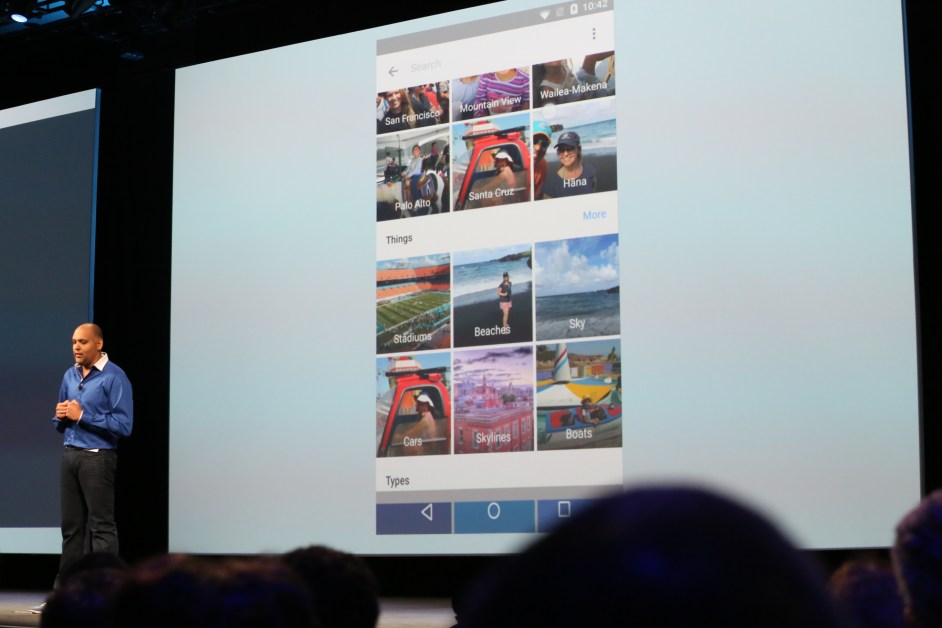
Google does. Its advanced computer vision, machine learning, artificial intelligence, and other technologies will let it determine what people, places, and things are in photos, and tie that data to your identity. Pics of you with your favorite soda or a motorcycle could tell it what to show you in ads. Locations ID’d by landmarks could help it predict what you’re searching for. And selfies with friends could clue Google in to who it should recommend you share something with.

The app even does the hard work of editing and curating photos. Its “Assistant” feature can balance out overexposure, turn burst shots into GIFs, and make little movies from your adventures. While pure file storage may have become a commodity anyone can offer, Google Photos does a lot that only the search giant could pull off.

According to interviews with Google VP Bradley Horowitz by Backchannel’s Steven Levy, the computer vision isn’t perfect yet, but that’s kind of the point of this launch. “The key to getting that last percentage which tips it over will come now, when we deploy it at scale. Getting all that data will create a virtuous cycle of getting better and better,” Horowitz says.

Comments

Popular posts from this blog

Build Your Own Awesome Personal 3D Avatar with Avatara

Do you use social networks and want to build your own awesome 3D avatar? Maybe you want to send someone a cute cuddly image of yourself (kind of)? Or maybe you have your own ideas of what you would do with an Avatar… Well look no further than Avatara which I discovered from the MakeUseOf directory . You can create 3d avatars out of pre-set up templates or create your own from scratch. To start, visit Avatara’s homepage . You will see this screen: Click Get Started to umm, get started! That will take you to this screen: You see that you can build your own Avatar using an uploaded head shot like the Obama one above (just an example, guys). Or roll with one of their awesome avatars. I chose to start with a blank avatar by clicking Start with a blank avatar at the bottom of the screen. That takes you to here: I clicked on the filter at the top and told it to filter out everything but male characters and then I saw this: I rolled with Buck and continued. You need to click Select...

MoviePass drops pricing to under $7 per month, if you opt for the annual plan

MoviePass, the subscription service that lets consumers pay a monthly fee to see unlimited movies in theaters across the U.S., is slashing its prices yet again. The company announced today it’s now offering its service for $6.95 per month, down from the current price of $9.95 per month, when customers commit to a one-year subscription plan. That works out to a flat fee of $89.95 annually. The deal is a limited-time promotion, as opposed to a permanent pricing change, but MoviePass didn’t say how long the offer is valid. However, it is open to both new and existing subscribers – the latter who would receive a 25 percent savings on their current subscription if switching over to the annual plan. This is not the first time that MoviePass has dropped its pricing. When the company introduced its $9.95 per month, one-movie-per-day plan this August, down from $15 for 2 movies per month (or more in select markets like L.A. and NYC, and going as high as $50), it saw so many new sign-up...

ASUS VivoBook X202E Windows 8 Touchscreen Laptop Review And Giveaway

It wasn’t very long ago when prices of touchscreen Windows 8 laptops soared beyond $1000. Thankfully, those days are behind us, and portable computers can easily be purchased – touchscreen and all – for under $500. That’s precisely the demographic in which the ASUS VivoBook X202E falls. When compared to a high-end laptop, its specifications might seem modest, but for laptop buyers just looking for a way to browse the web, watch videos, use basic apps, and not spend too much money, something in this budget is perfectly suitable. The question is, of course, how does the ASUS VivoBook X202E compare to others on the market, and is it the one which you should be spending your hard-earned money on? Well, you’re just going to have to keep reading to find out. Best of all, we are giving away an ASUS VivoBook X202E to one lucky winner. Keep reading for your chance to take home this Windows 8 touchscreen laptop! Introducing the ASUS VivoBook X202E Laptop The ASUS VivoBook X202...