
Immigrant Founders Need Policy Reform To Keep Creating Tech Jobs


President Obama took executive action last November to further ease policies around skilled tech labor. However, our laws haven’t done much to help the foreign startup founders who create quite a few tech jobs here.

A 2008 Kaufman Foundation study concluded that between 1995 and 2005, more than half of all Silicon Valley tech companies were created by immigrant founders, employing 560,000 workers and generating $63 billion in sales.

But something changed in 2006. There was a commonly estimated 12 million illegals living in America at the time. New reforms that were supposed to make it easier for immigrants who’d been here a while to obtain worker visas seemed to be making it harder for those with startups.

The Comprehensive Immigration Reform Act of 2006 allowed those who’d been in the country for 2-5 years to stay, but would required them to return to their country of origin after 3 years. Meanwhile, those who’d been here less than 2 years would have to leave.

Vivek Wadwha suggested in his book ‘The Immigrant Exodus’ that the changes to U.S. immigration policy was causing a brain drain in Silicon Valley.

This was seemingly confirmed in a follow-up Kaufman study, showing that the number of immigrant-founded startups dropped from 52 percent to less than 44 percent in 2012.

This suggests would-be Silicon Valley entrepreneurs were having a harder time getting the visas they needed to start businesses here.
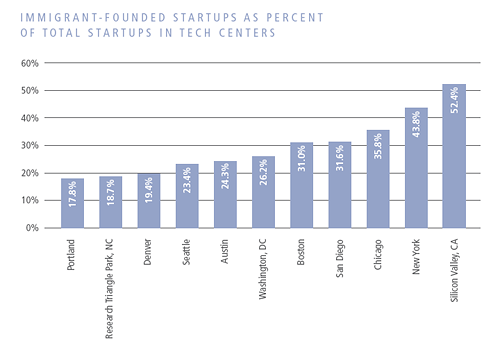
immigrantstartups
U.S. employers can currently sponsor foreign workers with a temporary H-1B visa. However, those visas are capped at 65,000 a year. This limits the amount of workers able to stay and add to the economy here. Further, immigrants trying to start their own company have no such employer sponsorship.

Canada saw an opportunity to poach Silicon Valley talent in 2013 with a billboard campaign strategically placed on the Peninsula of California’s highway 101. Signs read, “H-1B Problems? Pivot to Canada.”

Read More

Comments

Popular posts from this blog

Build Your Own Awesome Personal 3D Avatar with Avatara

Do you use social networks and want to build your own awesome 3D avatar? Maybe you want to send someone a cute cuddly image of yourself (kind of)? Or maybe you have your own ideas of what you would do with an Avatar… Well look no further than Avatara which I discovered from the MakeUseOf directory . You can create 3d avatars out of pre-set up templates or create your own from scratch. To start, visit Avatara’s homepage . You will see this screen: Click Get Started to umm, get started! That will take you to this screen: You see that you can build your own Avatar using an uploaded head shot like the Obama one above (just an example, guys). Or roll with one of their awesome avatars. I chose to start with a blank avatar by clicking Start with a blank avatar at the bottom of the screen. That takes you to here: I clicked on the filter at the top and told it to filter out everything but male characters and then I saw this: I rolled with Buck and continued. You need to click Select...

Fun Tools to Translate Your Name into Japanese Calligraphy

Japanese calligraphy is an artistic writing style of the Japanese language. Its Chinese origins can be traced back to the twenty-eighth century BCE. Calligraphy found its way into Japanese culture in 600 CE and is known as the karayo tradition. For Westerners, calligraphy is forever fascinating. However, it takes years to learn how to properly draw the signs. Two basic principles must be known to understand Japanese writing: there are different writing styles and different alphabets. Kaisho for example, is a writing style most commonly used in print media. Tensho on the other hand is used in signatures. Other writing styles are Reisho, Gyosho and Sousho. The alphabets include Kanji, Hiragana, and Katakana. Katakana is used for writing foreign words. It can also serve to highlight words, in analogy to capital letters as we know them from the Roman / Latin alphabet (Romaji in Japanese). Each Kanji character has a meaning of its own, while Hiragana or Katakana characters merely repres...

Boom, the startup that wants to build supersonic planes, just signed a massive deal with Virgin

Have you heard about Boom? Boom is a relatively new startup that’s aiming to build something pretty crazy. They’re not building an app… or a social network… or even some new gadget for the Kickstarter crowd. Boom wants to build planes. Really, really, really fast planes. Specifically, they’re trying to design and build a supersonic passenger plane that goes 2.2x the speed of sound. If all goes to plan, they’ll be able to shuttle people from New York to London in 3.5 hours, and SF to Tokyo in 4.5. Sound crazy? I wouldn’t disagree. It’s worth noting that the company is in the very early days for something as intensive, massive, and hugely expensive as designing and producing a passenger aircraft. They’re still working on their first prototype, and hope to fly it by late next year. But it’s also worth noting that the team behind the plane has some serious talent in its blood: the company’s 11 employees have collectively contributed to over 30 aircrafts — having worked on thin...