
Microsoft Begins Accepting Bitcoin For Windows, Windows Phone And Xbox Purchases


If you want further proof that Microsoft is going through a transformative phrase, you may be interested to hear that the company has jumped on the bitcoin wagon.

The Redmond-based tech giant is now accepting bitcoins for buying games and other digital content on its Windows, Windows Phone and Xbox platforms, as the folks at Coindesk noticed today. Members of Reddit’s bitcoin subred noted that Microsoft appears to be working with payments firm Bitpay to make this happen.

Neither Microsoft nor Bitpay have formally announced the partnership or details, but the former does have a series of instructions related to bitcoin payments within its ‘billing help’ pages.

We’ve contacted both companies for further information, but did not hear back at the time of writing.

There are some caveats to note, however. Customers can use bitcoin to load money into a Microsoft wallet or to create digital gift cards, but direct payments with the cryptocurrency are not supported at this time.

Finally, bitcoin payments appear to be limited to customers in the U.S., according to feedback from Reddit members.
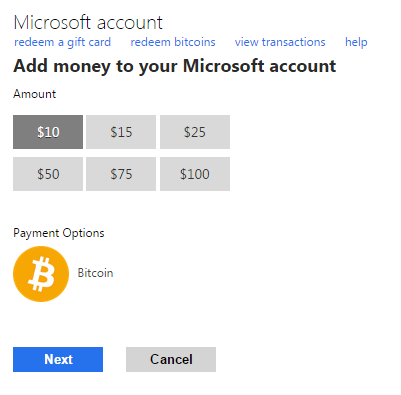
msft bitcoin
Microsoft is moving its business towards a new focus on services across a range of platforms under the leadership of CEO Satya Nadella, who took the company reins in February.

The company is traditionally considered to be a slow moving giant with one foot stuck in the past. Accepting Bitcoin doesn’t directly correlate to its recent (and somewhat surprising) moves to make its core services like Office available on rival platforms and using premium pricing models, but the fact that it is ready to embrace an upcoming technology before many of its rivals is a sign that Microsoft’s ethos may have modernized.

Comments

Popular posts from this blog

Fun Tools to Translate Your Name into Japanese Calligraphy

Japanese calligraphy is an artistic writing style of the Japanese language. Its Chinese origins can be traced back to the twenty-eighth century BCE. Calligraphy found its way into Japanese culture in 600 CE and is known as the karayo tradition. For Westerners, calligraphy is forever fascinating. However, it takes years to learn how to properly draw the signs. Two basic principles must be known to understand Japanese writing: there are different writing styles and different alphabets. Kaisho for example, is a writing style most commonly used in print media. Tensho on the other hand is used in signatures. Other writing styles are Reisho, Gyosho and Sousho. The alphabets include Kanji, Hiragana, and Katakana. Katakana is used for writing foreign words. It can also serve to highlight words, in analogy to capital letters as we know them from the Roman / Latin alphabet (Romaji in Japanese). Each Kanji character has a meaning of its own, while Hiragana or Katakana characters merely repres...

How To Hide Text In Microsoft Word 2007, Reveal It & Protect It

Sometimes what we hide is more important than what we reveal. Especially, documents with sensitive information, some things are supposed to be ‘for some eyes only’. Such scenarios are quite common, even for the more un-secretive among us. You want to show someone a letter composed in MS Word, but want to keep some of the content private; or it’s an official letter with some part of it having critical data. As important as these two are, the most common use could involve a normal printing job. Many a time we have to print different versions of a document, one copy for one set of eyes and others for other sets. Rather than creating multiple copies and therefore multiple printing jobs, what if we could just do it from the same document?  That too, without the hassle of repeated cut and paste. We can, with a simple feature in MS Word – it’s just called Hidden and let me show you how to use it to hide text in Microsoft Word 2007. It’s a simple single click process. Open the docum...

Boom, the startup that wants to build supersonic planes, just signed a massive deal with Virgin

Have you heard about Boom? Boom is a relatively new startup that’s aiming to build something pretty crazy. They’re not building an app… or a social network… or even some new gadget for the Kickstarter crowd. Boom wants to build planes. Really, really, really fast planes. Specifically, they’re trying to design and build a supersonic passenger plane that goes 2.2x the speed of sound. If all goes to plan, they’ll be able to shuttle people from New York to London in 3.5 hours, and SF to Tokyo in 4.5. Sound crazy? I wouldn’t disagree. It’s worth noting that the company is in the very early days for something as intensive, massive, and hugely expensive as designing and producing a passenger aircraft. They’re still working on their first prototype, and hope to fly it by late next year. But it’s also worth noting that the team behind the plane has some serious talent in its blood: the company’s 11 employees have collectively contributed to over 30 aircrafts — having worked on thin...